
Why this study? The policy context
Promoting well-being in digital education is a key priority across the European Union. As learning, communication and leisure increasingly take place through digital technologies, schools and families face a dual reality: digital tools can enhance learning, inclusion and participation, while also posing risks to learners’ cognitive, physical, social and emotional well-being.
A major policy milestone was the Council of the European Union’s 2022 Conclusions on supporting well-being in digital education, which consolidated earlier initiatives and set clearer directions for integrating well-being into digital education policies across Member States. This agenda is reinforced by the Digital Education Action Plan 2021–2027, alongside complementary EU legislation and policy initiatives, including the General Data Protection Regulation, the Digital Services Act, the 2022 Council Recommendation on Pathways to School Success, and the 2023 Council Conclusions on mental health.
Looking ahead, the European Commission’s 2024–2029 priorities place additional emphasis on the impacts of social media, addictive online designs and cyberbullying, while the 2025 Union of Skills highlights Artificial Intelligence literacy and updates to the Digital Competence Framework. Insights from this study will also feed into the EU 2030 Roadmap on the future of digital education and skills.
Against this backdrop, there has been a clear need for evidence-based and practice-oriented insights into what well-being in digital education means in real school contexts and how it can be effectively supported.
What we did
This study was carried out by the Joint Research Centre (European Commission) together with Visionary Analytics and a team of experts (P. Kampylis, A. Monge Roffarello (Polytechnic University of Turin) and V. Hillman), with the aim of deepening the understanding of well-being in digital education across the European Union.
The research combined:
- A comprehensive literature review and an analysis of EU and mapping national policy frameworks;
- fieldwork in 12 school communities across four Member States (Bulgaria, Greece, Lithuania and Finland);
- A Model of Emerging Practices in Promoting Well-being in Digital Education
- Optional SELFIE questions on Well-being in Digital Education
- consultations with a wide range of education stakeholders, including learners, educators, school leaders, parents, EdTech companies and policymakers.
The analytical scope covered primary, lower and upper secondary education, and initial vocational education and training (IVET), with a strong emphasis on a whole-school approach and community involvement.
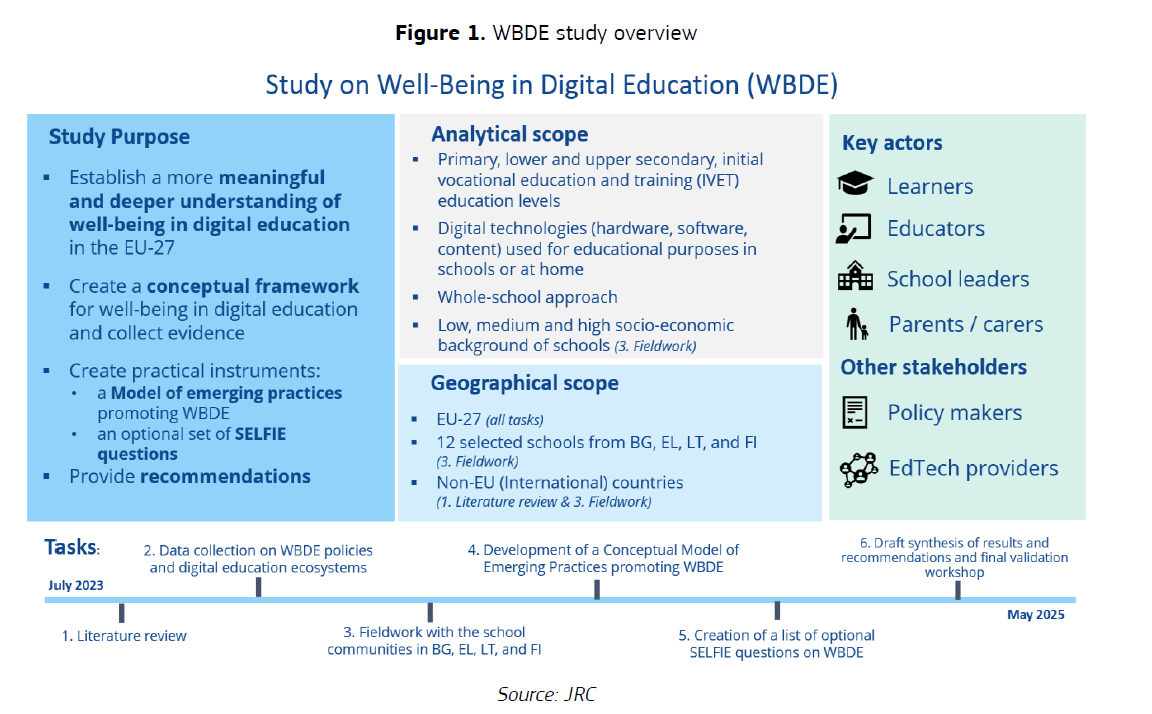
Figure 1. WBDE study overview.
What we found: key insights from schools and stakeholders
- Well-being requires integrated policies and school strategies
Promoting well-being in digital education cannot be addressed in isolation. It requires an integrated approach, aligning cross-sectoral policies (e.g., education, digital, health, child protection and inclusion) with coherent school-level strategies on both well-being and the use of digital technologies.
- Purposeful and balanced use of digital technologies matters
While digital technologies offer significant educational benefits (e.g., increased motivation and engagement, language learning, increased communication and social connections), the study highlights the importance of mindful, age-appropriate and purposeful use. Evidence points to well-being challenges such as fatigue, headaches, disrupted sleep, digital distraction, anxiety, cyberbullying. Balanced use, supported by unplugged pedagogies, is essential.
- Technology design plays a critical role
Well-being is shaped not only by usage, but also by how technologies are designed. Key aspects include data protection and privacy, safety and reporting mechanisms, accessibility for all learners (including those with special needs), and user-centric designs that foster positive social interactions.
- The digital divide remains a major challenge
Disparities in infrastructure, costs and digital competences, both at school and at home, continue to affect learners’ and educators’ well-being. Addressing these gaps is crucial to ensuring equitable access and preventing further inequalities.
- Whole-school approaches show strong potential
Emerging practices underline the effectiveness of whole-school approaches that combine leadership, collaboration and shared responsibility. Involving learners, educators, school leaders, parents and the wider community (supported by training and awareness-raising) was found to be particularly impactful.
- Collaboration across stakeholders is essential
The recommendations stress the importance of cooperation between policymakers, school leaders, teachers, parents, education technology providers and health professionals. Sustainable solutions depend on joint action across school, home and policy environments.
- Continuous research is needed in a rapidly evolving digital landscape
Well-being in digital education is evolving quickly, particularly with the expansion of Artificial Intelligence and immersive technologies. Ongoing research is needed to inform timely policy responses on issues such as cognitive development, mental resilience, harmful content exposure, distraction, multi-device screen time and effective cooperation models with EdTech providers.
From evidence to action: practical outputs
To support stakeholders in practice, the study developed:
- a Model of Emerging Practices for Well-Being in Digital Education, offering a flexible framework structured around key domains and guiding principles;
- an optional set of SELFIE questions on WBDE, enabling schools to reflect on and discuss well-being in digital education in a structured way;
- evidence-based recommendations for policymakers, education leaders and practitioners.
We would like to thank JRC and DG EAC, our team of experts and all stakeholders involved in the study -especially the 12 school communities engaged, whose valuable insights greatly enriched our understanding of well-being in digital education.
Interested in learning more?
Explore the full study results, including the Model of Emerging Practices and detailed recommendations, here: https://op.europa.eu/en/publication-detail/-/publication/5aa5277b-eaad-11f0-8d3c-01aa75ed71a1/language-en